Most junk cars sell for $200 to $700. Sellers who follow the right steps consistently push their offers into the $500 to $1,200 range on the same vehicles. The difference is not luck, negotiation tricks, or finding a secret buyer. It’s knowing what determines your car’s value, presenting it accurately, and selling to the right type of buyer for your specific vehicle.
At Reap My Ride, we buy thousands of junk cars every year across the United States. We see price variations daily, and we know exactly which factors increase or decrease an offer by 20-40%. Most sellers lose money because they don’t know what matters, what doesn’t, and how buyers actually think. This guide covers every step that moves the dollar amount, starting with the ones that have the biggest financial impact.
The fastest way to increase your junk car payout is to keep the vehicle complete (every missing component reduces the offer), get 3 to 5 quotes from different buyer types (sellers who do this receive 20-40% more than those who accept the first offer), and confirm the offer is guaranteed in writing before scheduling pickup (this prevents the bait-and-switch price drop that is the number one complaint in the industry). Everything else in this guide builds on those three fundamentals.
1. Keep the Vehicle Complete
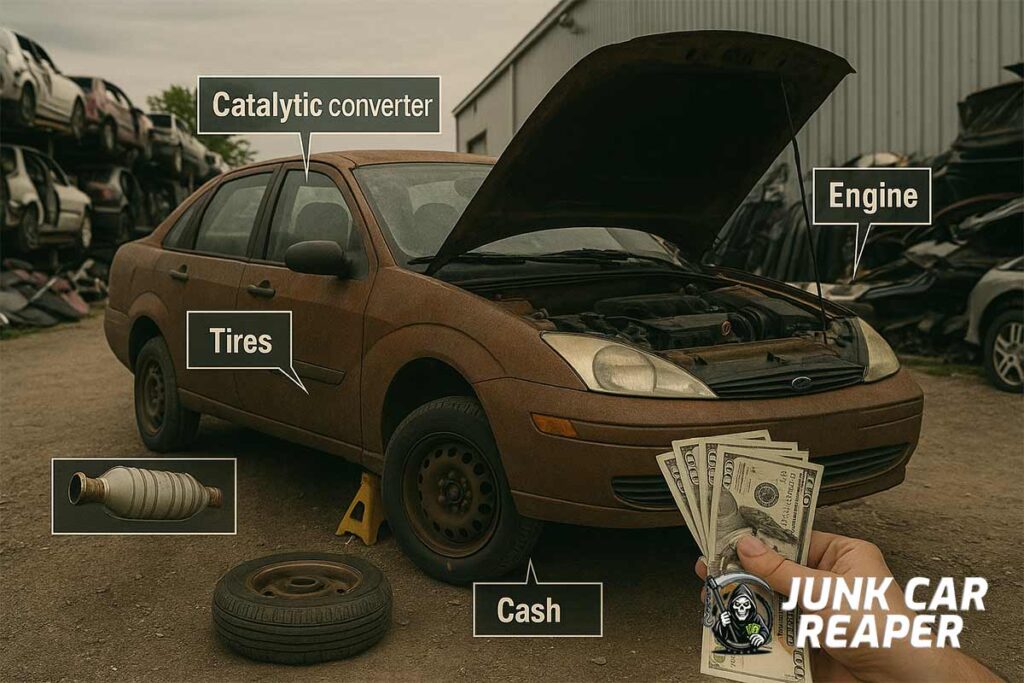
Every component you remove from the vehicle before selling it reduces the buyer’s offer, because that’s a piece of value the buyer can no longer capture. A missing catalytic converter reduces the offer by $50 to $400. Missing wheels reduce it by $40 to $200. A missing engine drops the value by $200 to $600. A missing battery, alternator, or starter reduces it by $15 to $50 each. These deductions add up fast.
The one exception is aftermarket add-ons: stereos, subwoofers, GPS units, seat covers, LED light kits, lift kits, and other accessories you installed yourself. These add zero value to a junk car offer because buyers value metal, OEM parts, and catalytic converter content, not aftermarket accessories. Remove those items and sell them separately on Facebook Marketplace or Craigslist. You can get $20 to $200 per item instead of giving them away for nothing.
The general rule: keep everything that came with the car from the factory. Remove everything you added to it afterward.
2. Know Your Scrap Floor Before You Talk to Anyone
Before you call a single buyer, calculate your vehicle’s base scrap value yourself. This is the absolute minimum your car is worth: the price a scrap-only yard would pay based on nothing but steel weight. Knowing this number prevents you from accepting an offer below the floor, which happens more often than you’d think when sellers have no reference point.
The calculation is simple. Find your vehicle’s curb weight (check the sticker on the driver’s door jamb or search your year, make, and model online), divide by 2,000 to convert to tons, and multiply by your state’s current per-ton scrap rate. At the current national average of roughly $175 per ton, a 3,300-pound midsize sedan has a scrap floor around $289. A 5,000-pound pickup truck has a floor around $438. These are the numbers nobody should pay you less than.
The scrap floor is just the starting point. A complete vehicle with a working engine, intact catalytic converter, and clean title is worth $50 to $400 more than its scrap floor because those components have independent resale value that a scrap-only yard ignores. Your goal is to capture as much of that additional value as possible.
3. Understand What Your Catalytic Converter Is Worth
The catalytic converter is the single component that creates the biggest swing in junk car offers. An intact factory-original converter can add $50 to $400 or more to your vehicle’s value depending on the make, model, and current precious metal prices. Toyota and Honda converters sit at the top of the range. Economy car converters sit at the bottom. Hybrid vehicles like the Toyota Prius have converters worth $300 to $1,000+ because the hybrid drivetrain preserves the precious metal content better than conventional engines.
When you call a buyer for a quote, they will ask about the converter. If you don’t know the answer, find out before you start collecting offers. Crawl under the vehicle (or have someone else look) and confirm the converter is present and hasn’t been cut off. If it’s missing, say so upfront. If it was replaced with an aftermarket unit at some point, mention that too. Being accurate about the converter prevents the most common cause of offer changes at pickup: the buyer quoted you assuming an OEM converter, arrived to find an aftermarket or missing one, and dropped the price by $100 to $400.
4. Get 3 to 5 Quotes and Understand Why They Differ
Never accept the first offer. Different buyers use different valuation models, and the gap between the lowest and highest quote on the same vehicle can be $75 to $500 or more. Scrap-only yards price based on weight alone. Junk car buyers who resell parts price based on weight plus components. Salvage auction buyers price based on wholesale resale potential. Each model produces a different number for the same car.
Call at least two local scrap yards, one or two junk car buyers, and get an online offer from Reap My Ride. When you compare, pay attention to what’s included in each quote. Does the scrap yard’s price include towing, or will they deduct $50 to $150 for pickup? Is the junk car buyer’s quote guaranteed, or “subject to inspection” (which is code for “might change when the driver shows up”)? The highest number on paper isn’t always the highest number in your pocket if hidden fees or quote changes eat into it.
From what we see every day, sellers who collect 3 to 5 quotes consistently receive 20% to 40% more than sellers who accept the first offer. That’s not because later quotes are magically higher. It’s because having multiple numbers gives you a baseline to evaluate each offer against, and it sometimes gives you leverage to push a preferred buyer upward.
5. Demand a Guaranteed Offer in Writing
The single most common complaint in the junk car industry is the bait-and-switch: a buyer quotes one price on the phone, the tow truck shows up, and the driver says the offer has changed. Sometimes the drop is $50. Sometimes it’s $200 to $300. The reasons given are always the same: “the catalytic converter isn’t what we expected,” “the car is in worse condition than described,” or “my manager says we can’t do that price.” At that point, the seller feels stuck because the tow truck is already there and they just want the car gone.
Before you confirm any sale, ask this exact question: “Is this offer guaranteed as long as the vehicle matches what I described?” If the buyer hedges, says “subject to inspection,” or can’t give you a direct yes, they’re preparing to drop the price at pickup. Move on to the next buyer. About 1 out of every 5 cars we inspect has an issue the seller forgot to mention, especially missing or swapped catalytic converters. That always affects the price. But if you described the car accurately and the buyer confirmed the price, it should hold.
Reap My Ride’s offer is guaranteed as long as the vehicle matches your description. The offer is calculated using real-time market data for your specific vehicle’s year, make, model, condition, and component status. If what the driver finds matches what you described, you get paid exactly what was quoted. No renegotiation on your driveway.
6. Make Sure Towing Is Free
Hidden towing fees are the second most common way sellers lose money. A buyer quotes $400, shows up, and says “minus $100 for the tow.” Now your $400 offer is a $300 offer. Some sellers don’t even realize the deduction happened because the buyer presents it as standard practice.
When you collect quotes, ask explicitly: “Is towing 100% free, with no pickup fee, mileage charge, or deduction from the offer?” If the answer is anything other than an unqualified yes, factor the towing cost into your comparison. A $350 offer with free towing is better than a $400 offer with a $100 towing deduction. Reap My Ride provides free flatbed towing on every transaction with no fees or deductions of any kind. The quoted price is the price you receive.
7. Be Accurate When Describing Your Vehicle
Your description determines your offer. Every junk car buyer makes sight-unseen offers based on the information you provide: year, make, model, condition, what’s broken, what’s missing, whether it runs, and whether the catalytic converter is present and original. If your description is inaccurate, the offer will change at pickup when the driver inspects the vehicle, and the change is never in your favor.
Be specific about the problem that’s making you sell. “Blown engine” is more useful than “doesn’t run.” “Transmission slips in third gear” is more useful than “needs work.” If the catalytic converter was stolen or replaced with an aftermarket unit, say so. If the car has been sitting for two years and you’re not sure if it starts, say that. If there’s frame rust, body damage, or missing components, mention them. Buyers price accuracy. The more accurate your description, the less room there is for a surprise at pickup that changes the number.
8. Have Your Title Ready
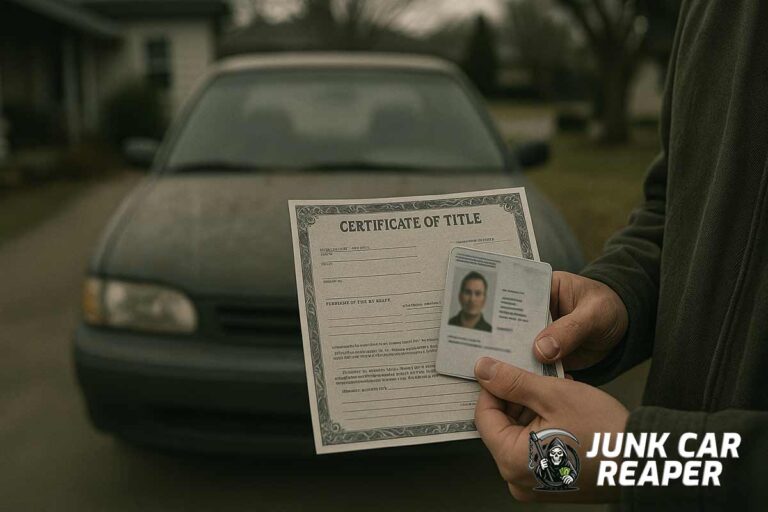
A clean title in your name gives the buyer maximum disposition flexibility, which translates to a higher offer. Without a title, the buyer’s options narrow to scrap processing and parts-only sales through a licensed dismantler, which reduces what they can afford to pay.
Based on our data, junk cars without titles sell for roughly $190 less on average than the same vehicle with a title. A duplicate title from your state’s DMV typically costs $30 to $50 and takes 1 to 3 weeks to process. If you have time, getting the duplicate before selling is almost always worth the small fee. If you don’t have time, many junk car buyers including Reap My Ride can still purchase without a title using alternative proof of ownership (registration, valid photo ID, and in some states a bill of sale).
9. Don’t Wait
A junk car sitting on your property is not holding its value. It’s losing value every day. Every month your car sits, you pay $50 to $125 in insurance and registration on a vehicle you’re not driving. The battery dies. Rubber seals and hoses dry out and crack. Brake rotors seize to pads. Fluids settle and degrade. Weather exposure accelerates corrosion on undercarriage components. Parts that were viable last month may not be viable next month.
Some sellers wait for scrap prices to rise. Scrap steel follows a seasonal pattern: slightly higher in spring and summer, softer in winter. The typical seasonal swing is $15 to $25 per ton, which translates to roughly $15 to $40 on a typical passenger vehicle. That potential gain is almost always wiped out by one to two months of holding costs. Many sellers also forget to cancel their insurance on a car they’re not driving and lose $40 to $120 in prorated refunds that they could have recovered by selling sooner.
Sell when you’re ready, not when you think the market will peak. If your car’s repair costs exceed half its post-repair market value, the financial case for selling is already clear. Waiting doesn’t improve the math. It makes it worse.
What Does NOT Increase Your Junk Car Offer
This is where most generic advice gets it wrong. A junk car is not a retail used car. You do not need to wash it. You do not need to vacuum it. You do not need to fix cosmetic damage, replace headlights, inflate tires, add fluids, or make any repair of any kind. None of these actions increase your junk car offer by a single dollar. Junk car buyers care about metal weight, parts condition, catalytic converter content, and title status. They do not care about curb appeal.
Spending $200 on a repair to make a junk car “more presentable” is $200 wasted. Spending $50 on a detail is $50 wasted. The only pre-sale actions that matter are: remove your personal belongings (check the glove box, center console, under seats, trunk, and spare tire well), remove your license plates if your state requires it, and cancel your insurance after the sale to collect any prorated refund. That insurance refund is often $40 to $120 in found money that sellers forget about.
What Actually Matters vs. What Doesn’t
Biggest impact: catalytic converter presence and type (OEM vs. aftermarket vs. missing), vehicle weight (heavier vehicles have a higher scrap floor), engine condition (running vs. non-running), and who you sell to (scrap yard vs. junk car buyer vs. private sale).
Moderate impact: title status (clean vs. missing, roughly $190 difference on average), vehicle completeness (every missing component reduces the offer), year, make, and model (parts demand varies by vehicle), and number of quotes collected (3-5 quotes = 20-40% more than the first offer).
Zero impact: washing or detailing the vehicle, fixing cosmetic damage, inflating tires, adding fluids, replacing headlights or wipers, vacuuming the interior, or any other money spent on a vehicle you’re selling for parts and scrap.
Does Parting Out a Junk Car Pay More?
In theory, yes. A car that would sell for $500 as a complete vehicle might yield $1,500 to $3,000 in individual parts if you pull and sell the engine, transmission, catalytic converter, wheels, doors, headlights, and electronics separately. The math looks compelling on paper.
In practice, parting out is a completely different activity from selling a junk car. It requires mechanical tools and knowledge to remove components without damaging them. It requires space to store parts while they’re listed for sale. It requires weeks to months of managing online listings, responding to inquiries, packaging, shipping, and dealing with returns. And 30% to 50% of listed parts may never sell at all, leaving you with a stripped shell worth less than the complete car would have been, plus an inventory of unsold components taking up space.
Parting out makes sense for one specific type of seller: someone with mechanical skills, a workspace, time to spare, and experience selling auto parts online. For everyone else, selling the complete vehicle to a buyer who captures parts value in the offer produces a better net result when time, effort, and sell-through rates are factored in. For the full breakdown of when parting out makes financial sense and when it doesn’t, see our complete guide to parting out a junk car.
Top Mistakes That Cost Sellers Money
After purchasing thousands of junk cars, these are the mistakes we see every week that keep sellers from getting the most cash possible. Accepting the first offer without comparing. Hiding problems that get discovered at pickup and trigger a price drop. Forgetting to mention missing or aftermarket catalytic converters. Paying for towing when free options exist. Selling without a title when a $30 to $50 duplicate was available. Trusting unlicensed buyers who use bait-and-switch tactics. Leaving valuable personal items inside the vehicle. Waiting months while the car depreciates and holding costs accumulate. And spending money on washing, detailing, or repairing a car that’s being sold for parts and scrap.
Every step in this guide is designed to prevent those mistakes. The sellers who follow them consistently receive the highest payouts. The ones who don’t leave money on the table.
Frequently Asked Questions
How much can I get for my junk car?
Most junk cars sell for $200 to $700, with complete vehicles in good structural condition bringing $500 to $1,200+. The specific number depends on your vehicle’s weight, catalytic converter status, engine condition, parts demand for your year, make, and model, title status, and your local scrap market. Trucks and SUVs consistently bring more than sedans because they weigh more and their parts command higher wholesale prices.
What is the fastest way to sell a junk car?
Get an instant offer online from Reap My Ride, schedule free pickup, and receive cash when the driver arrives. The entire process from quote to cash in hand typically takes 24 to 48 hours. There’s no need to list the car, field calls, negotiate with strangers, or arrange your own towing.
Should I fix my junk car before selling it?
No, do not fix your car before selling it. Junk car buyers price on metal weight, parts condition, and catalytic converter content. Repairs, cleaning, and cosmetic fixes add zero value to a junk car offer. Every dollar you spend on repairs is a dollar wasted. The only exception is if the repair would bring the car back to running, driveable condition and the repair cost is well below 50% of the car’s post-repair value. In that case, you might be better off repairing and selling as a used car rather than as junk.
Do I need a title to sell my junk car?
A title is preferred but not always required. Reap My Ride buys vehicles without titles in most states using alternative proof of ownership (valid photo ID plus registration or bill of sale). Selling without a title typically reduces the offer by roughly $190 on average because it limits the buyer’s disposition options. If you have time, a duplicate title from your state DMV ($30 to $50) usually pays for itself through the higher offer.
Why do different buyers offer different amounts for the same car?
Because they use different valuation models. Scrap yards price on weight alone. Junk car buyers price on weight plus parts plus catalytic converter. Salvage auction buyers price on wholesale resale potential. A scrap yard might offer $300 on a car that Reap My Ride would offer $450 for, because Reap My Ride captures the engine, converter, and parts value that the scrap yard ignores. This is why getting multiple quotes matters.
How do I avoid getting scammed when selling a junk car?
Three rules cover 90% of scam prevention. First, only work with licensed, verified buyers. Ask for their business license or salvage dealer number. Second, demand a guaranteed offer in writing before scheduling pickup. If the buyer can’t confirm the offer is firm, they’re planning to drop it when the tow truck arrives. Third, never let the vehicle leave your property without receiving full payment first. Cash at pickup, counted in your hand before the car goes on the flatbed.
When is the best time to sell a junk car?
The best time to sell your junk car is now. Scrap prices follow seasonal patterns (slightly higher in spring and summer, softer in winter), but the typical swing adds only $15 to $40 to a vehicle’s value. Meanwhile, a non-running car costs $50 to $125 per month in insurance and registration, and parts deteriorate from sitting. The holding costs of waiting almost always exceed the potential gain from a seasonal price increase. If your car needs a repair that costs more than half its value, the math already favors selling today.
Get the Most Cash for Your Junk Car
You now know more about junk car valuation than 95% of sellers. The steps above protect you from every common mistake and position you to receive the highest possible offer for your vehicle. If you’re ready to see what yours is worth, Reap My Ride’s offer captures scrap weight, parts demand, catalytic converter value, and local buyer competition in a single number. Free towing, guaranteed pricing, cash at pickup.